The year we went open source
As ONLYOFFICE celebrates its 16th anniversary, we’re looking back at the moments that shaped our journey. In our series, we revisit the ideas, decisions, and milestones that helped transform a small collaboration platform into the office suite millions use.
Today, we’re stopping at one of the most significant turning points in our history: the year we went open source.
The changing face of open source
By 2014, open source was no longer viewed as something only developers cared about. More users and organizations were choosing open source software not only for its flexibility, but also for the transparency and control it offered.
As digital tools became an essential part of everyday work, organizations became more conscious of how their software handled data, and control and trust grew more important. They wanted to understand how the tools they relied on worked, where their data was stored, and whether they could deploy and customize software on their own terms.
These changing expectations are reflected in our solutions as well.
Our way to open source
In 2014, we reached an important milestone. In January, we introduced TeamLab Server Community for open source supporters, offering a freely downloadable server version for those who wanted to deploy and work with the platform on their own infrastructure.
That release showed that the product was already moving toward a more open model, with a focus on self-hosting and community access.
By July, the project had turned 4 and was no longer a toddler. It had outgrown its earliest steps, changed its name, and was ready for a more independent life.
We officially opened the source code of the entire application under AGPL v3, making ONLYOFFICE a 100% open source solution. That included the online document editors, collaborative editing, the Gantt chart, and invoicing features.
By showing you the underside, we affirm ONLYOFFICE transparency and reliability. We realize that data security is a burning issue for most companies, especially when it comes to documents. Considering this, we have nothing to hide and nobody to hide from.
This was the moment when ONLYOFFICE fully stepped into the open source world, not as an experiment or a side project, but as a clear product direction.
When Desktop Editors opened its code
Two years later, in October 2016, we released the source code of ONLYOFFICE Desktop Editors, bringing the same principles of transparency and openness to our offline applications.
It became free for both personal and commercial use, and any user could study how the desktop editors work and modify them to suit their preferences.
Building an open ecosystem
Going open source gave new opportunities beyond ONLYOFFICE itself. In November 2016, we introduced plugin support, allowing developers to add new functionality and tailor ONLYOFFICE to different workflows.
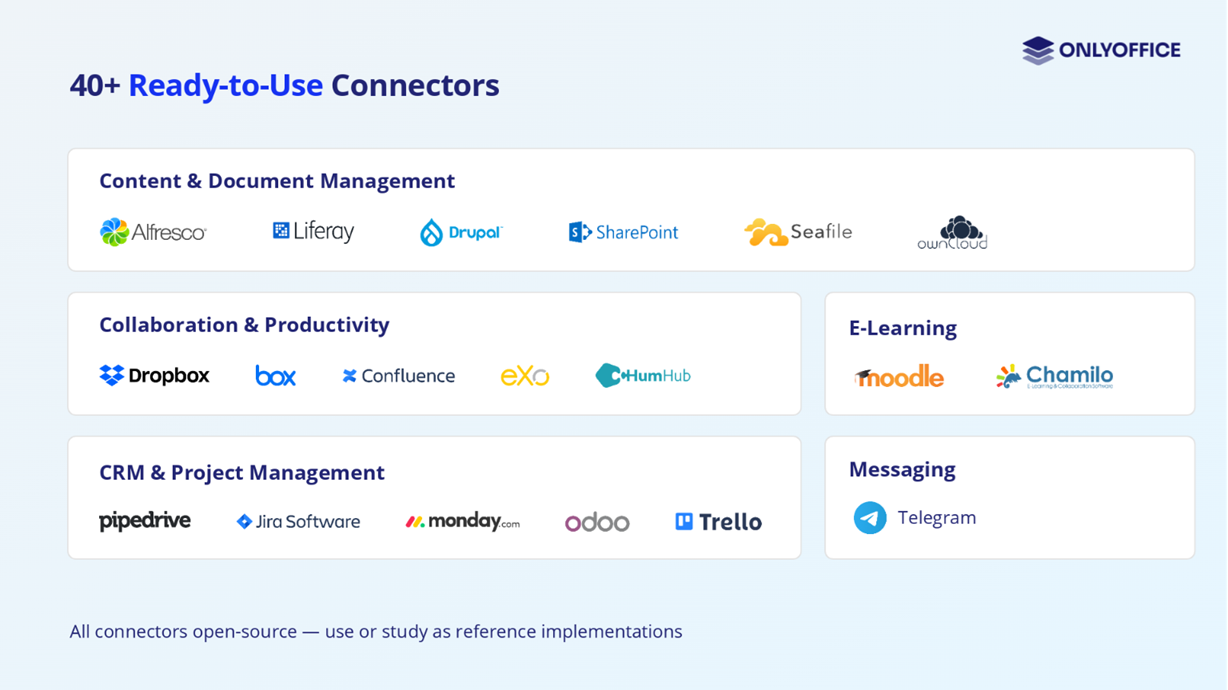
As the ecosystem grew, so did the possibilities for developers, technology partners, and the community. New integrations with open source platforms such as ownCloud and Nextcloud made it easier to edit and collaborate on documents within familiar environments.
What started with a handful of integrations has since grown into an ecosystem of more than 40 official connectors, enabling users to edit and collaborate on documents within the platforms they already use.
Workspace gets even more open
Our open-source journey didn’t stop with the editors and integrations.
In 2020, ONLYOFFICE Groups, the collaboration platform that was a part of ONLYOFFICE Workspace, became available under the Apache 2.0 license. The change made it easier for organizations, service providers, and developers to deploy, customize, and distribute the platform as part of their own solutions.
Together with our open-source document editors, it marked another important step toward the flexible, interoperable Workspace.
Open by design: DocSpace
By the time we launched ONLYOFFICE DocSpace in 2023, open source was no longer just a milestone in our history — it had become part of how we created new products.
Our new collaboration platform introduced secure room-based collaboration, allowing users to co-author, review, and share documents with flexible access permissions. Unlike TeamLab, which became open source several years after its launch, DocSpace embraced this philosophy from day one.
Why it mattered
For users, this meant more than access to code. It meant trust, flexibility, and the freedom to build around a platform they could inspect, deploy, and adapt.
For the product, it meant a stronger foundation for long-term development. Open source matched the way ONLYOFFICE was evolving: toward openness, interoperability, and a collaborative model that fit the needs of modern work.
Looking back now, 2014 stands out as the year when everything came together. The product had matured. The direction was clear. And the name ONLYOFFICE finally reflected what the platform had become.
Stay tuned for article five!
Create your free ONLYOFFICE account
View, edit and collaborate on docs, sheets, slides, forms, and PDF files online.